
On this page
What gutter repairs are most common in McKinney?
Most repairs here trace back to three things: heat, hail and the age of the house. Summer heat bakes sealant until corners leak. Spring hail dents gutters, crushes downspouts and can knock runs out of slope. And on older houses, spikes loosen in fascia that has been wet too often, until runs sag and pull away.
Water pours over the front of the gutter in a spring thunderstorm
The gutter is too small for the roof, an outlet is blocked or there are too few downspouts for the heavy bursts McKinney gets in April and May. Overflowing gutters
A steady drip from a corner, end cap or seam
Sealant cracks after years of summer heat and winter cold. Most joints can be cleaned, re-riveted and resealed. Leaking gutters
A run that bows between hangers or leans away from the fascia
Spikes have backed out, hangers are spaced too far apart, or the board behind them has gone soft. Sagging gutters
Dents, dimples or crushed downspouts after hail
Hail marks aluminum gutters and downspouts quickly. Photograph the damage from the ground with the date before anything is repaired. Hail and storm damage
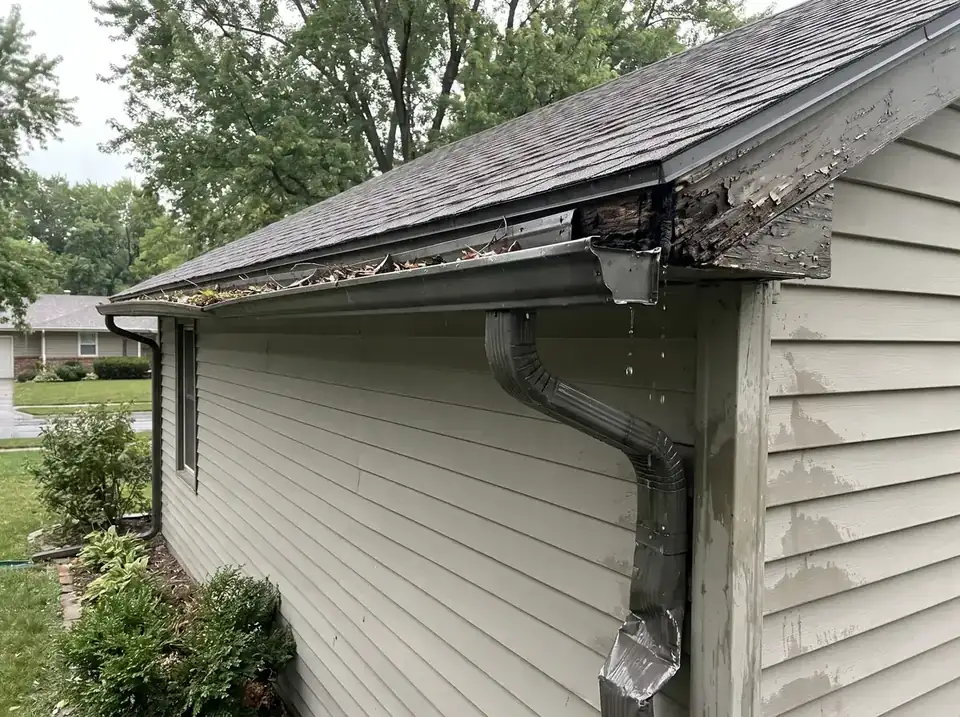
A trough packed with oak leaves, elm seeds and pecan debris
Debris dams the outlet, the gutter holds water, and the next storm spills it over the front. Gutter cleaning
A downspout that gurgles, overflows at the top or empties against the slab
A clogged elbow or a missing extension puts water where it should not go. Downspout repair
Soggy beds along the foundation after rain, cracked dry soil in August
Clay soil that swings from soaked to parched moves the slab. Downspouts should release water well clear of the house. Downspout drainage
| Problem | Usual cause | Usual repair | Page |
|---|---|---|---|
| Leaking corner or seam | Sealant broken down by heat and age | Clean, re-rivet and reseal | Leaking gutters |
| Sagging run | Spikes loose, hangers too far apart, soft fascia | Rehang on hidden hangers, fix fascia | Sagging gutters |
| Overflow in storms | Undersized gutter, too few outlets, debris | Clean, add outlets, larger downspouts | Overflowing gutters |
| Dents and crushed downspouts | Hail | Replace damaged sections | Hail and storm damage |
| Downspout clogged or loose | Debris in elbows, broken straps | Clear, re-strap, extend | Downspout repair |
| Rotten fascia or soffit | Water behind the gutter for years | Replace boards, add drip edge | Fascia and soffit |
Repair or replace?
A few problems on a sound system are worth repairing. Widespread problems on an old one usually are not. As a rough rule, if more than a third of the corners leak, several runs sag, the metal is dented along whole sides or the gutters are thin sectional pieces joined every 10 feet, get a replacement price too. The repair or replace guide walks through the decision.
| Sign | Lean toward repair | Lean toward replacement |
|---|---|---|
| Leaks | One or two corners | Corners and seams all around |
| Sagging | One section | Several runs, spikes throughout |
| Hail damage | A few dents, one downspout | Dents along whole sides, split seams |
| Age | Under 15 years, seamless | 20-plus years, sectional |
| Fascia | Sound | Soft in many places |
Why does fixing the cause matter?
A gutter repair that does not fix the cause comes back. Reseal a corner that leaks because the run slopes the wrong way and it will leak again. Rehang a run on the same soft fascia and it will sag again. Patch an overflowing gutter that is simply too small for the roof above it and it will still overflow every April. A good contractor will tell you the cause as well as the fix.
The foundation connection
On McKinney's clay, gutter problems become foundation problems. A leaking corner or overflowing run drops water in the same patch of soil every storm, while the rest of the slab dries out. North Texas clay shrinks and expands with moisture, causing foundations to shift up and down, according to The Dallas Morning News. That is why even small gutter faults are worth fixing promptly here.
What should you ask before a repair?
- What is causing the problem, not just what does it look like?
- Will the repair last, or is replacement better value?
- Is the fascia sound behind the gutter?
- Are the downspouts big enough, and where do they empty?
- Is hail damage visible elsewhere that I should document?
Parts you will hear about
| Term | What it means on a McKinney house |
|---|---|
| Miter | The cut, riveted and sealed joint at an inside or outside corner, and the most likely place for a leak. |
| End cap | The piece that closes each end of a run, crimped on and sealed. |
| Spike and ferrule | The older way of hanging gutter: a long nail through a sleeve. Heat, wind and the weight of water work it loose. |
| Hidden hanger | A bracket that clips under the gutter's front lip and screws through the back into the fascia, out of sight from the street. |
| Fascia | The board across the ends of the rafters. Gutters screw into it, so a soft or split fascia loosens every hanger on the run. |
| Drip edge | Bent metal flashing on the edge of the roof deck that throws water forward into the gutter instead of letting it curl back onto the fascia. |
| Outlet | The hole in the gutter bottom where the downspout connects, usually with a riveted drop sleeve. |
| Downspout | The vertical pipe, also called a leader, that brings water to the ground. Common sizes are 2x3 and 3x4 inches. |
| Hail dent | A round dimple pressed into gutter or downspout metal by a hailstone. Shallow dents are cosmetic; crushed downspouts and split seams are not. |
When should repairs happen?
As soon as you notice the problem, ideally before spring storms. After a hailstorm, photograph damage from the ground with the date before anything is touched, and contact your insurer before repairs start if you plan to make a claim.