
On this page
- Why do McKinney gutters clog?
- Which guard types are there?
- What works best under each tree?
- Do guards change the gutter size you need?
- Guards and hail
- What should you ask before buying guards?
- Gutter guards at a glance
- Where gutter guards matters around McKinney
- A first step worth taking
- Guards on new homes
- Guards and the foundation
- Checking guards each year
- Guard terms
- When to install guards
Why do McKinney gutters clog?
Clogs come from the trees above the roof. The shade trees most often planted in North Texas include live oak, cedar elm, bur oak and pecan, according to Texas A&M AgriLife Extension in Dallas County. Each fills gutters differently:
- Cedar elm drops lots of small seeds in autumn as well as its leaves, according to The Dallas Morning News.
- Bur oak is messy, with huge leaves and big acorns, the paper noted.
- Live oak sheds its leaves in spring as the new ones emerge, according to a City of Killeen tree guide, so its gutters clog at the opposite time of year from most trees.
- Pecan drops catkins in spring and nuts and husks in autumn. AgriLife advises not planting pecans too close to the house.
Roof grit from aging shingles adds to it. A gutter that is half full of debris has half the capacity when the next storm hits.
Which guard types are there?
| Type | How it works | Best for | Weak points |
|---|---|---|---|
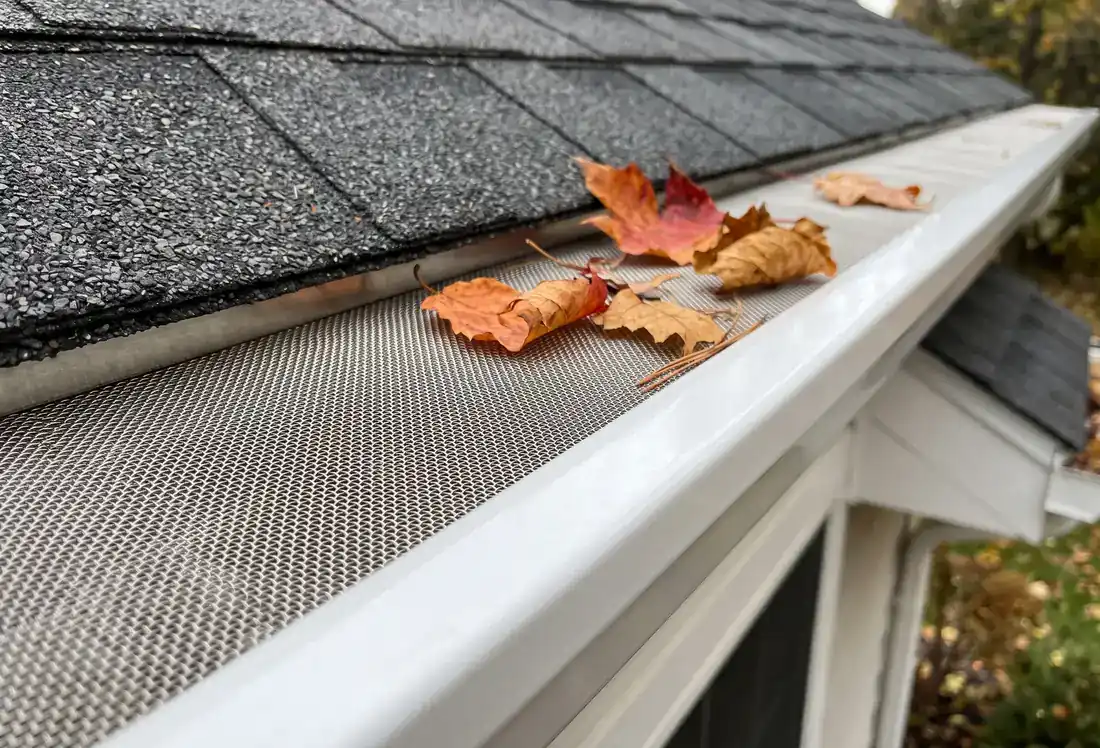
| Stainless micro-mesh | Fine mesh on a frame over the gutter | Most trees, including elm seeds and grit | Higher cost; needs occasional brushing |
| Screen | Perforated panel with larger holes | Large leaves like bur oak | Lets seeds and grit through |
| Reverse-curve hood | Water follows a curved nose into the gutter | Large leaves | Can overshoot in downpours; visible from the street |
| Foam insert | Porous block in the trough | Low budget | Traps fine debris; breaks down in sun |
| Brush insert | Bristles in the trough | Easy DIY | Holds debris; needs pulling out to clean |
See micro-mesh guards and screen and reverse-curve guards for detail.
What works best under each tree?
| Tree over the roof | Main debris | Guard that usually works |
|---|---|---|
| Cedar elm | Small leaves, many seeds | Micro-mesh |
| Bur oak | Huge leaves, acorns | Micro-mesh or heavy screen |
| Live oak | Small leaves in spring, catkins | Micro-mesh |
| Pecan | Catkins, husks, leaves | Micro-mesh on a stiff frame |
| Young landscape trees | Very little | Often none needed yet |
Do guards change the gutter size you need?
A guard does not add capacity. If a gutter overflows in heavy rain with no debris in it, a guard will not help. Fix the size and outlets first: see overflowing gutters. Then add the guard.
Guards and hail
Spring hail in Collin County can dent guard frames and tear lightweight screens. Stainless mesh on an aluminum frame usually survives better than plastic or thin perforated aluminum. After a hailstorm, check guards along with the gutters and photograph any damage.
What should you ask before buying guards?
- Which guard type, and why for my trees?
- Are the gutters sound and properly pitched first?
- How does the guard attach, and does it go under the shingles?
- How often will it need brushing off?
- Is the price for guards alone, or with cleaning first?
Gutter guards at a glance
| What people ask | Short answer |
|---|---|
| Do guards stop birds and pests? | They keep nesting out of the trough. |
| Can guards be removed? | Yes, for cleaning or repair. |
| Do guards work on half-round? | Some are made for it. |
| Are guards worth it on new homes? | Usually not yet. |
Where gutter guards matters around McKinney
| Neighborhood or town | Why it comes up there |
|---|---|
| Stonebridge Ranch | Mature trees |
| Historic McKinney | Pecans and oaks |
| Fairview | Creek-side lots |
| Lucas | Large trees on acreage |
A first step worth taking
Before buying guards, have the gutters cleaned and checked. A guard on a sagging or leaking gutter hides the problem.
Guards on new homes
On newer homes with young trees, guards are rarely needed yet. As trees grow over ten or fifteen years, the picture changes. Fitting guards when trees start overhanging the roof is often the right time.
Guards and the foundation
Guards keep outlets clear between cleanings, which means fewer overflows in spring storms. On clay soil, fewer overflows means less water dropped along the slab.
Checking guards each year
Even with guards, take a look once a year: brush off matted debris, check that fasteners are tight, and look under a section or two for buildup in the trough.
Guard terms
| Term | What it means on a McKinney house |
|---|---|
| Micro-mesh guard | A fine stainless mesh on a frame over the gutter that stops leaves, elm seeds and roof grit while letting rain through. |
| Screen guard | A perforated panel with larger holes. It stops leaves and pecan husks but lets small seeds and grit through. |
| Reverse-curve guard | A solid hood whose curved nose leads water into the gutter while leaves slide off. In a cloudburst water can shoot past it. |
| Foam insert | A porous block laid in the trough. Cheap, but it fills with fine debris and breaks down in Texas sun. |
| Drip edge | Bent metal flashing on the edge of the roof deck that throws water forward into the gutter instead of letting it curl back onto the fascia. |
| Valley diverter | A small fin in the gutter under a roof valley that stops a rush of water from jumping the front edge. |
When to install guards
Late summer or early autumn is a good time: after the heat, before cedar elm seeds and oak leaves fall. Spring works too, ahead of storm season. The are gutter guards worth it guide looks at the cost against years of cleaning.