
On this page
Why do gutters sag?
| Cause | What you see | Fix |
|---|---|---|
| Spikes backing out | Heads of spikes sticking out of the gutter face | Replace with hidden hangers |
| Hangers too far apart | Run bows between fasteners | Add hangers about every 2 feet |
| Soft fascia | Hangers pulling out of the wood | Replace fascia, then rehang |
| Water standing in the trough | Run bows where water collects | Re-pitch toward outlets |
| Debris load | Heavy, packed gutter | Clean, then consider guards |
| Ice | Run pulled down after a freeze | Rehang and check hangers |
Spikes and older houses
Older houses, and some built through the 1990s, still have gutters hung on spike and ferrule: a long nail through a sleeve into the fascia. Years of summer heat and winter cold make the wood expand and shrink around the spike, and the weight of wet debris pulls on it. Eventually the spikes back out. In McKinney's older neighborhoods, such as the streets around the square in Historic McKinney, sagging on spikes is one of the most common gutter problems.
Ice and snow
McKinney gets little snow, about 2.3 inches in an average year, according to Wikipedia, but ice storms happen. A gutter loaded with ice on loose hangers can be pulled down in a single night.
Rehanging
- The run is unfastened and lowered or supported.
- The fascia is checked; soft boards are replaced.
- The run is re-pitched toward its outlets.
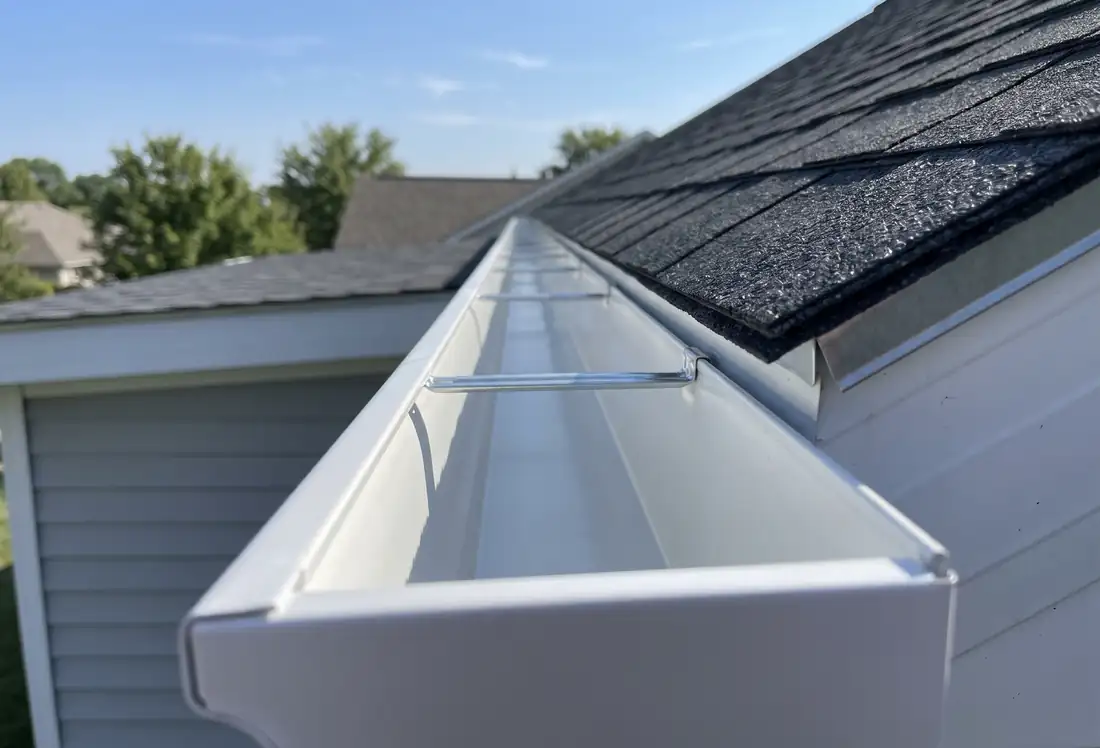
- Hidden hangers are screwed through into sound wood, ideally reaching the rafter tails, about every 2 feet.
- Joints disturbed in the process are resealed.
When to replace instead
If the gutter is old, sectional, kinked or dented by hail along its length, rehanging it may not be worth the labor. Replacement with seamless gutter on new hangers fixes the sag and the other problems together.
Sagging and foundations
A sagging run holds water in the low spot and spills it over the front in every storm, always in the same place. On McKinney's clay that means one patch of soil beside the slab stays soaked. Fixing the sag fixes the spill.
Terms
| Term | What it means on a McKinney house |
|---|---|
| Spike and ferrule | The older way of hanging gutter: a long nail through a sleeve. Heat, wind and the weight of water work it loose. |
| Hidden hanger | A bracket that clips under the gutter's front lip and screws through the back into the fascia, out of sight from the street. |
| Fascia | The board across the ends of the rafters. Gutters screw into it, so a soft or split fascia loosens every hanger on the run. |
| Rafter tail | The end of a rafter behind the fascia. A hanger screw that bites into it holds far better in a straight-line wind than one gripping trim alone. |
| Slope | The fall of the gutter toward its outlet, often about a quarter inch per 10 feet. Too little fall leaves standing water in the trough. |
| Strap hanger | A hanger fastened to the roof deck under the shingles, used where there is no fascia board to screw into. |
What should you ask?
- Why is it sagging?
- Is the fascia sound?
- What hangers, at what spacing?
- Will the slope be corrected?
Sagging gutters at a glance
| What people ask | Short answer |
|---|---|
| Can I tighten the spikes back in? | They usually loosen again; hidden hangers last longer. |
| How far apart should hangers be? | About every 2 feet is common. |
| Can a sagging gutter cause leaks? | Yes; joints open as the run bends. |
| Is sagging covered by insurance? | Usually not, unless caused by a covered storm. |
Where sagging gutters matters around McKinney
| Neighborhood or town | Why it comes up there |
|---|---|
| Historic McKinney | Spikes in old fascia |
| Stonebridge Ranch | 1990s gutters on original fasteners |
| Anna | Older houses near the town center |
| Celina | Older homes near the square |
A first step worth taking
Look along each run from the end of the house. A straight gutter has a slight, even fall to its outlets. Any dip that holds water after rain is worth fixing before the spring storms.
Sagging after hail
Hail can bend hangers and knock runs out of line. A gutter that sags after a storm may have bent hangers rather than loose ones. Photograph it for insurance before rehanging.
Sagging on newer homes
Newer homes can sag too, usually where hangers were spaced too widely or screwed only into trim. Adding hangers at about 2-foot spacing into solid wood normally fixes it.