
On this page
How are seamless gutters made?
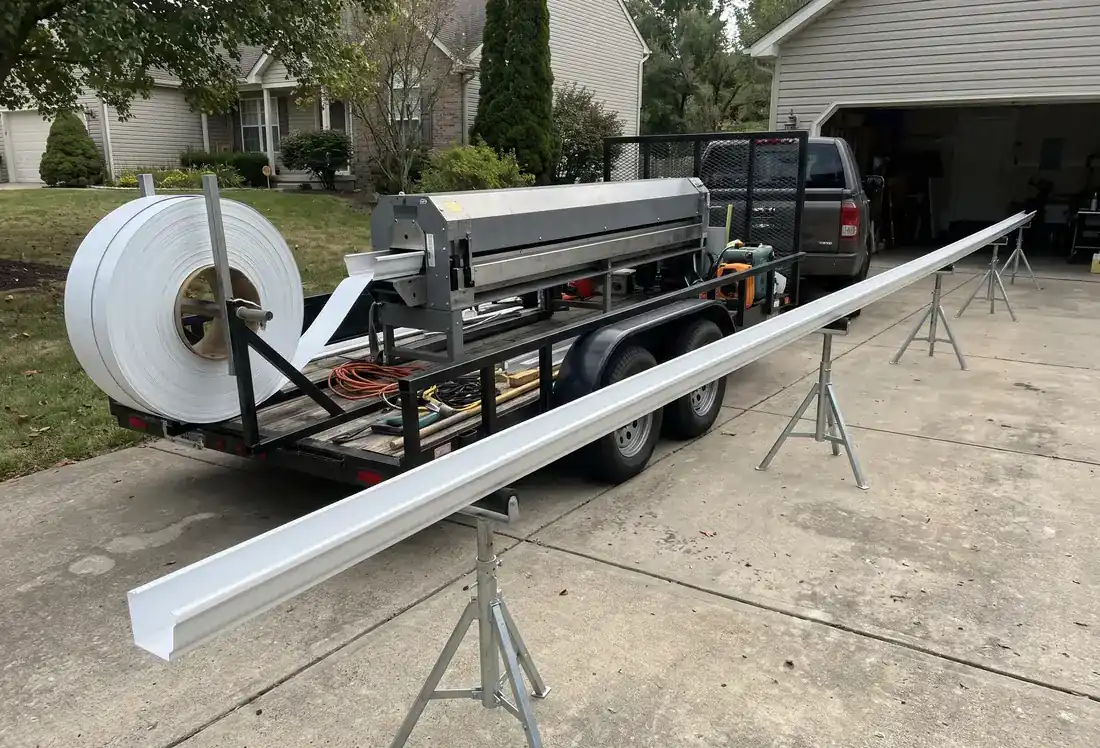
A contractor tows a gutter machine to the house. Painted coil feeds through rollers that bend it into the gutter profile, and the machine cuts each piece to the length measured from the eave. The run is carried to the ladders, fitted with end caps and outlets, and hung on the fascia in one piece.
The result has no joints along its length. A typical McKinney house might end up with eight to fourteen joints in total, at corners and ends, instead of dozens on a sectional system.
Why do joints matter in McKinney?
Every joint is held by sealant and rivets. Sealant ages with heat and sun, and McKinney's summers are long and hot; the city's record high is 118°F, according to Wikipedia. In winter the same metal contracts in freezes. Each cycle works at the joints. Joints also catch debris: the lip of a connector inside a sectional gutter is a ledge where elm seeds and roof grit collect and start a dam.
Then the storms arrive. McKinney averages about 41 inches of precipitation a year, with May the wettest month at about 5.7 inches, according to Wikipedia. A joint that has opened over the summer drips straight onto the soil beside the slab, which on clay is exactly where water should not land.
Seamless or sectional?
| Feature | Seamless | Sectional |
|---|---|---|
| Joints along a run | None | Every 10 or 20 feet |
| Where leaks start | Corners and end caps | Corners, end caps and every connector |
| Installed by | A contractor with a machine | Contractor or homeowner |
| Typical metals | Aluminum, steel, copper | Vinyl, aluminum, steel |
| Debris catch points | Few | Every connector |
| Upfront cost | Higher per foot | Lower per foot |
See the seamless vs sectional guide.
Which profiles and sizes are available?
- 5-inch K-style: common on one-story homes with simple roofs.
- 6-inch K-style: more capacity and a stiffer section for two-story homes and large roofs; see 6-inch gutters.
- Half-round: for historic and traditional-style homes; see half-round gutters.
- Larger commercial profiles: for long roofs on offices, retail and apartment buildings.
What thickness should be used?
Aluminum seamless gutter comes mostly in .027 and .032 inch. The thicker coil costs more but dents less in hail, holds its shape better when a ladder leans on it, and keeps its line on long runs. In Collin County, where large hail is a regular spring event, .032 is usually worth the difference. See aluminum gutters.
How should seamless gutters be hung here?
- Hidden hangers screwed into the fascia about every 2 feet, closer on exposed lots with no tree cover.
- Slope of about a quarter inch per 10 feet so water does not stand.
- Drip edge in place so water lands in the trough, not behind it.
- Expansion joints on very long runs, common on large custom homes in Fairview and Lucas.
- Outlets placed so downspouts can drain toward ground that falls away from the slab.
Colors and HOAs
Seamless coil comes pre-painted in dozens of colors. Most McKinney homes are brick, and common choices are white, almond, bronze and black, or a color matched to the trim. In many master-planned communities, such as Stonebridge Ranch and Craig Ranch, associations review exterior colors, so check before choosing something new.
Parts on a seamless system
| Term | What it means on a McKinney house |
|---|---|
| Seamless gutter | Gutter formed on site from a coil into one continuous piece for each wall, so the only joints are at corners and ends. |
| Coil stock | The roll of pre-painted aluminum, steel or copper that feeds the seamless gutter machine on the trailer. |
| K-style gutter | The standard flat-backed profile with a shaped front. It holds more water than a half-round gutter of the same width. |
| Hidden hanger | A bracket that clips under the gutter's front lip and screws through the back into the fascia, out of sight from the street. |
| Miter | The cut, riveted and sealed joint at an inside or outside corner, and the most likely place for a leak. |
| End cap | The piece that closes each end of a run, crimped on and sealed. |
| Outlet | The hole in the gutter bottom where the downspout connects, usually with a riveted drop sleeve. |
| Slope | The fall of the gutter toward its outlet, often about a quarter inch per 10 feet. Too little fall leaves standing water in the trough. |
What should you ask about seamless gutters?
- What profile and size for each side?
- .027 or .032 coil?
- How many joints, and where?
- What hangers, at what spacing?
- Where will each downspout go?
- Which colors are available, and do I need HOA approval?