
On this page
Why downspouts matter so much in McKinney
Most McKinney houses sit on concrete slabs over Blackland Prairie clay. That clay has a high shrink-swell property and can cause serious damage to foundations, according to the Texas Almanac as quoted by The Dallas Morning News. When roof water from one downspout soaks the same patch of soil every storm, that part of the slab sits on swollen clay while the rest sits on dry, shrunken clay. The difference is what makes foundations move.
The American Society of Civil Engineers' shallow foundations committee advises keeping the soil sloped away from the house on all sides, at least 3 inches of fall in the first 5 feet and preferably 6 inches in 10 feet, and using gutters and downspouts to carry roof water away, according to its shrink-swell soils flyer.
Sizing
| Downspout | Approximate capacity | Where it fits |
|---|---|---|
| 2x3 inch | Smaller roof areas | One-story homes, small runs |
| 3x4 inch | Roughly twice 2x3 | Most homes, two-story runs, valleys |
| 3-inch or 4-inch round | With half-round gutters | Historic and traditional homes |
| 4x5 inch and up | Large roof areas | Commercial buildings |
Many homes built in the last thirty years came with 2x3 downspouts. Swapping to 3x4 is one of the most effective upgrades a McKinney homeowner can make.
Placement
- One for every 30 to 40 feet of gutter, more under valleys.
- At the low end of each run, so water does not travel far.
- Away from walks and driveways where water would freeze in a cold snap.
- Toward ground that falls away from the house.
Discharge options
| Option | How it works | Best for |
|---|---|---|
| Splash block | Spreads the flow at the base | Ground already sloping away |
| Extension | Carries water a few feet out | Most homes, cheap and quick |
| Flip-up extension | Folds up for mowing | Lawns |
| Buried drain line | Solid pipe underground to a pop-up emitter or lower ground | Clay soil, flat lots, tight side yards |
| Rain barrel | Stores water for the garden | Back and side yards |
Buried lines and the street
On many McKinney lots, the best place for roof water is the street or a rear swale the lot was graded toward. Buried lines can carry it there. Stormwater in McKinney is not treated before it reaches the nearest creek or lake, according to the City of McKinney, so keep lawn chemicals and debris out of the flow. Ask the city before connecting anything to public drainage.
Downspouts and hail
Downspouts take the worst of hail. Crushed downspouts restrict flow and can back water up into the gutter. After a storm, check every downspout, not just the gutters. See hail and storm damage.
Terms
| Term | What it means on a McKinney house |
|---|---|
| Downspout | The vertical pipe, also called a leader, that brings water to the ground. Common sizes are 2x3 and 3x4 inches. |
| A elbow | An elbow that bends forward or back, used to bring the downspout from the overhang in to the wall. |
| B elbow | An elbow that bends to the side, used to steer the pipe around windows, hose bibs and corners. |
| Downspout extension | A length of pipe or a hinged section that carries water several feet from the wall before letting it go. |
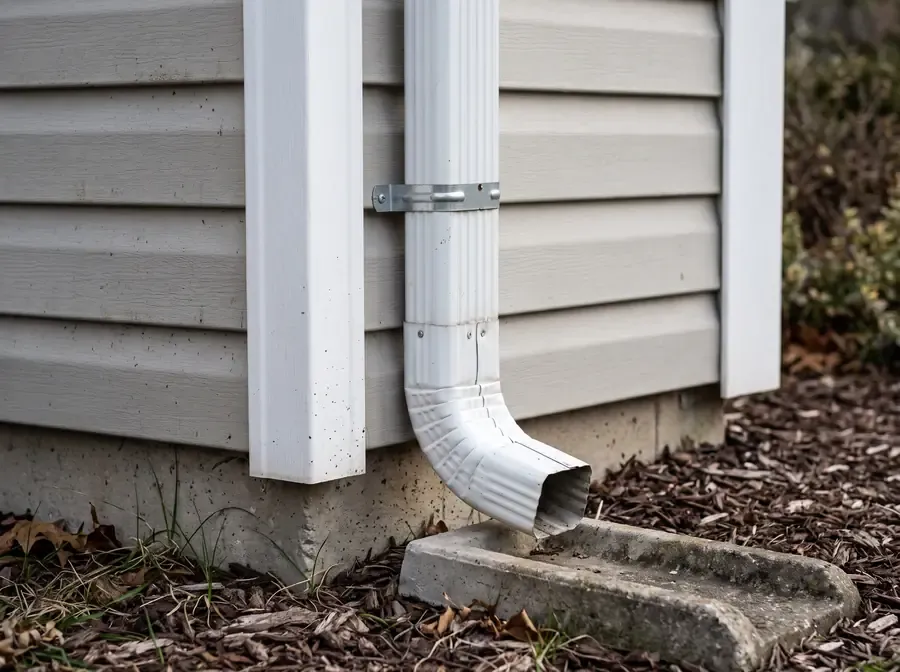
| Splash block | A concrete or plastic tray under a downspout that spreads the flow so it does not dig a hole by the slab. |
| Buried drain line | Solid pipe run underground from a downspout to a lower spot in the yard, a curb outlet or a pop-up emitter. |
| Pop-up emitter | A spring-loaded cap at the end of a buried line that opens when water pushes up and closes when the line drains. |
| Rain barrel | A covered container under a downspout that stores roof water for the garden, with an overflow pointed away from the house. |
| Expansive clay | Soil that swells when wet and shrinks when dry. Much of Collin County sits on Blackland Prairie clay of this kind, so where roof water lands matters. |
| Slab foundation | A concrete foundation poured on the ground, the usual type under McKinney houses. Uneven wetting of the clay beneath it is what makes it move. |
What should you ask?
- 2x3 or 3x4, and why?
- How many downspouts, and where?
- Where will each one discharge?
- Are buried lines worth it on this lot?
See also downspout repair and the drainage guide.
Downspouts at a glance
| What people ask | Short answer |
|---|---|
| Can I bury a downspout myself? | Many homeowners do, using solid pipe with steady fall; avoid perforated pipe next to the slab. |
| How deep should a buried line be? | Shallow is usually fine; enough to protect it from mowers. |
| Will an extension damage my lawn? | Flip-up extensions avoid mower damage. |
| Can two downspouts share one buried line? | Often, if the pipe is sized for both. |
Where downspouts matters around McKinney
| Neighborhood or town | Why it comes up there |
|---|---|
| Craig Ranch | Narrow side yards between houses |
| Trinity Falls | New slabs on clay |
| Lucas | Large lots with room to carry water far |
| Historic McKinney | Water under porches and older floors |
| Melissa | New builds with downspouts at the wall |
A first step worth taking
Walk the house in the next rain and note where each downspout's water ends up. Anywhere it pools within a few feet of the slab is where a longer extension or buried line will help most.